
Filter by Brand


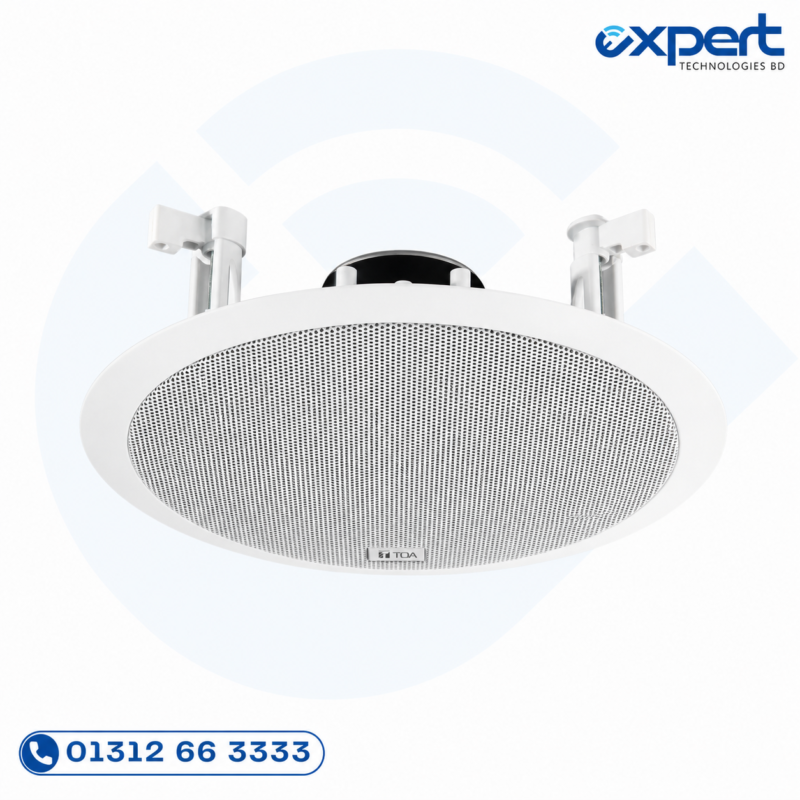

Ceiling Speaker Price in Bangladesh
The price of a ceiling speaker depends on more than wattage alone. Brand quality, driver design, transformer type, frequency response, mounting system, enclosure construction, and whether the speaker supports a professional 70V/100V PA line can all affect the final cost.
Popular Ceiling Speaker Prices at Expert Technologies BD
| Model | Power / System | Current Price |
|---|---|---|
| Ahuja CS-5061T | 6W, 100V PA Ceiling Speaker | ৳3,200 |
| Ahuja CS-6081T | 8W, 100V PA Ceiling Speaker | ৳4,000 |
| Bosch LBC 3087/41 | 6W, 100V Flush-Mount Ceiling Loudspeaker | ৳5,300 |
Price Notice: Product prices may change depending on stock availability, exchange rates, import costs, brand pricing, and order quantity. Check the product listing or contact Expert Technologies BD for the latest ceiling speaker price in Bangladesh.
What Is a Ceiling Speaker?
A ceiling speaker is a loudspeaker designed to be installed in or on a ceiling so that speech, announcements, and background music can be distributed evenly across an indoor space.
In commercial Analogue PA System installations, ceiling speakers commonly use a 70V or 100V line transformer with selectable wattage taps. This allows several speakers to be connected to one compatible amplifier and distributed across offices, hospitals, schools, restaurants, hotels, banks, shopping malls, and other facilities.
Unlike conventional wall-mounted loudspeakers, flush-mount ceiling speakers remain visually discreet and use the ceiling area to provide distributed sound coverage without occupying wall or floor space.
How Does a PA Ceiling Speaker Work?
A commercial ceiling speaker normally forms one part of a complete PA audio system:
Microphone / Audio Source → PA Amplifier → 70V/100V Speaker Line → Ceiling Speaker Transformer → Speaker Driver
Audio Source
Speech, announcements, or background music enters the system through a microphone, media player, computer, mixer, or another compatible audio source.
PA Amplifier
The PA Amplifier processes and amplifies the audio before distributing it through the speaker circuit.
The amplifier's rated output must be sufficient for the combined wattage load of all connected ceiling speakers.
70V/100V Speaker Line
Professional distributed PA installations commonly use constant-voltage speaker lines.
The speaker transformer allows multiple compatible speakers to operate on the same line while installers calculate the system load using each speaker's selected wattage tap.
Ceiling Speaker
The loudspeaker converts the amplified electrical signal into audible speech or music and distributes it into the room below.
Why Are Ceiling Speakers Used in Commercial PA Systems?
Ceiling speakers are especially useful where the objective is to distribute sound across an indoor area rather than project extremely high volume from one location.
Clean Interior Appearance
A flush-mounted speaker integrates into the ceiling and avoids occupying walls or floor space.
This makes ceiling speakers practical for:
- Corporate offices
- Hospitals
- Clinics
- Banks
- Restaurants
- Hotels
- Shopping malls
- Retail stores
- Schools
- Conference areas
More Even Sound Distribution
Instead of relying on one loud speaker at the front of a room, multiple ceiling speakers can be distributed throughout the area.
Correct placement can help maintain more consistent speech and background-audio levels across the space.
Suitable for Paging and Background Music
Commercial ceiling speakers are commonly designed for both voice announcements and light background music.
The required model should still be selected according to frequency response, speaker construction, wattage, and the intended application.
Easy Integration with 70V/100V PA Systems
Transformer-equipped ceiling speakers can be integrated into a distributed analogue PA network with compatible amplifiers and other speaker types.
Types of Ceiling Speakers
Not every ceiling speaker is designed for the same purpose. Understanding the main types helps avoid choosing a speaker based only on price.
Full-Range Ceiling Speaker
A full-range model uses a driver designed to reproduce a broad range of voice and music frequencies from one speaker assembly.
These models are commonly used for:
- General announcements
- Paging
- Light background music
- Office communication
- Classroom audio
Two-Way or Coaxial Ceiling Speaker
A two-way or coaxial ceiling loudspeaker normally separates lower/mid-frequency and higher-frequency reproduction between different driver elements.
These models may be preferable where better music reproduction and wider frequency response are important.
Professional JBL ceiling models, for example, are available with coaxial designs, broad coverage patterns, and support for both 70V/100V and low-impedance operation.
100V PA Ceiling Speaker
A 100V ceiling speaker contains a line transformer that allows it to operate from a compatible 100V PA amplifier.
This is one of the most practical formats for commercial buildings requiring multiple speakers.
70V Ceiling Speaker
Some professional speakers support 70V distribution as well as 100V.
Always match the speaker setting with the amplifier output configuration.
Low-Impedance Ceiling Speaker
Some ceiling speakers can operate at conventional low impedance, such as 8Ω.
Low-impedance systems are different from distributed 70V/100V PA systems and require proper impedance calculation rather than simply adding wattage taps.
70V/100V Ceiling Speaker vs 8Ω Ceiling Speaker
One of the most important decisions when selecting a ceiling speaker is whether the project requires a constant-voltage PA system or a conventional low-impedance audio system.
| Feature | 70V/100V Ceiling Speaker | 8Ω Ceiling Speaker |
|---|---|---|
| Typical Application | Commercial distributed PA | Local audio systems |
| Multiple Speakers | Easy to distribute when designed correctly | Requires impedance planning |
| Load Calculation | Add speaker tap wattages | Calculate total impedance |
| Long Cable Runs | Common in distributed PA | System dependent |
| Transformer | Usually included | Normally not required |
| Best For | Offices, schools, hospitals, malls | Smaller/local audio setups |
Bosch and JBL professional ceiling loudspeakers provide examples of transformer-based systems with selectable 70V/100V taps, while some JBL models also support low-impedance operation.
For most building-wide paging projects using an analogue PA architecture, the amplifier and speaker system should be planned together rather than mixing incompatible connection methods.
What Do 3W, 6W, 10W and 15W Ceiling Speaker Taps Mean?
In a 70V/100V PA system, the wattage tap determines how much amplifier power each speaker uses.
For example, a speaker may allow different settings such as:
-1.5W / 3W / 6W or -2W / 4W / 8W
depending on the model.
A lower tap can be used where only moderate sound level is required, while a higher tap may be selected for areas requiring greater output.
Bosch's professional ceiling loudspeaker designs, for example, use transformer taps that allow the installer to select different power levels on a 100V line.
The correct tap should be selected according to:
- Room size
- Speaker spacing
- Ceiling height
- Background noise
- Required sound level
- Amplifier capacity
- Number of connected speakers
How to Calculate Ceiling Speaker Load
Correct load calculation is essential before selecting the amplifier.
For a 70V/100V system:
Total Speaker Load = Number of Speakers × Selected Wattage Tap
Example 1: 10 Ceiling Speakers at 6W
10 × 6W = 60W total speaker load
The amplifier must provide sufficient rated output to support this connected load with appropriate design headroom.
Example 2: 20 Ceiling Speakers at 6W
20 × 6W = 120W total speaker load
A suitable amplifier should therefore provide capacity above the connected 120W load, considering the manufacturer's recommendations and any expected future expansion.
Example 3: Different Tap Settings
Suppose an office has:
- 10 speakers × 6W = 60W
- 10 speakers × 3W = 30W
Total:
60W + 30W = 90W
This flexibility allows different areas to operate at different output levels while remaining on a compatible distributed system.
How Many Ceiling Speakers Can One Amplifier Support?
There is no fixed answer because the number depends on the wattage tap selected for each speaker and the amplifier's rated capacity.
For example:
A 120W amplifier does not automatically mean a fixed number of speakers.
If each speaker is set to:
- 3W → 20 speakers use 60W
- 6W → 20 speakers use 120W
- 10W → 12 speakers use 120W
However, professional system design should not assume that running exactly at the amplifier's maximum rating is appropriate for every project.
Allow suitable design headroom according to the amplifier manufacturer's specifications and system requirements.
How to Choose Ceiling Speaker Wattage
Higher wattage is not automatically better.
The correct wattage depends on the environment.
3W–6W Ceiling Speakers
Often suitable for quieter areas such as:
- Offices
- Clinics
- Hospital corridors
- Banks
- Classrooms
- Small retail areas
6W–10W Ceiling Speakers
Can suit locations requiring somewhat stronger coverage or mixed speech and background music, such as:
- Restaurants
- Hotels
- Showrooms
- Larger offices
- Training centres
15W and Higher
Higher-output ceiling models may be considered where greater sound level, music performance, higher ceilings, or wider coverage is required.
The actual selection should be based on the speaker's full specifications rather than wattage alone.
Ceiling Speaker Size: 4", 5", 6" or 8"?
Driver size can affect sound character, frequency response, installation dimensions, and required ceiling cutout.
4-Inch Ceiling Speakers
Compact models can work well where ceiling space is limited or where many speakers are distributed across smaller areas.
5-Inch and 6-Inch Speakers
These are widely used for commercial paging and background-audio applications.
Your current Ahuja CS-6081T, for example, uses a 6-inch full-range driver with an 8W/4W/2W 100V tap configuration.
8-Inch Ceiling Speakers
Larger drivers may provide greater output and improved low-frequency extension depending on the speaker design.
Always check the ceiling cutout, mounting depth, backcan requirements, and available ceiling space before purchasing.
Ceiling Speaker Placement and Coverage
Buying the correct speaker is only part of a successful installation.
Poor placement can create areas that are too loud, too quiet, or difficult to understand.
Ceiling Height
Higher ceilings increase the distance between the speaker and listeners and can change the required speaker spacing and output.
Coverage Angle
Different models have different dispersion patterns.
For example, JBL professional ceiling models include designs with approximately 110°–130° nominal coverage depending on the model.
This demonstrates why one universal speaker-spacing rule should not be applied to every model.
Room Layout
Walls, corridors, partitions, furniture, shelving, and open areas can affect how sound is distributed.
Background Noise
Quiet offices require less output than busy commercial areas.
Speaker quantity and tap settings should therefore be selected according to the real environment.
Best Ceiling Speakers for Different Applications
Office Ceiling Speaker
Office systems normally prioritize clear paging, low-level background music, clean appearance, and even sound coverage.
A typical setup may use several 3W–6W or similar transformer-equipped speakers connected to a compatible PA amplifier.
Hospital and Clinic Ceiling Speaker
Ceiling speakers are commonly used in:
- Waiting rooms
- Corridors
- Reception areas
- General public areas
- Administrative sections
Where a system is used for emergency evacuation or other life-safety functions, the required equipment and compliance standards should be evaluated separately.
Restaurant and Café Ceiling Speaker
Restaurants often require consistent background music without installing visually prominent loudspeakers on walls.
Ceiling speakers can provide distributed audio above dining areas, reception spaces, and other indoor zones.
Where music quality is a higher priority, frequency response and speaker design should be considered alongside wattage.
Hotel Ceiling Speaker
Hotels may use ceiling speakers in:
- Lobbies
- Corridors
- Restaurants
- Reception areas
- Meeting rooms
- Common areas
Different zones may require different volume levels and speaker tap settings.
School and College Ceiling Speaker
Schools can use ceiling speakers for:
- Classroom announcements
- Administrative paging
- General communication
- Corridor audio
- Background audio
A central PA amplifier can distribute announcements to several rooms or zones when the system is properly designed.
Bank and Corporate Office Ceiling Speaker
Banks and corporate facilities often prefer flush-mounted speakers because they integrate neatly with modern interiors.
They can support staff paging, customer announcements, background music, and other routine communication.
Shopping Mall and Retail Ceiling Speaker
Retail environments may use ceiling speakers for:
- Promotional announcements
- Customer paging
- Background music
- General communication
Larger sites should be divided into logical zones rather than using one volume level throughout the entire building.
Mosque Ceiling Speaker
Ceiling speakers can be used for indoor prayer-hall speech distribution where the ceiling design and acoustic requirements make them appropriate.
For outdoor Azan or long-distance projection, a Horn Speaker or another suitable speaker type may be more appropriate than an indoor ceiling speaker.
Ceiling Speaker vs Other PA Speaker Types
The right speaker depends on where and how the sound must be delivered.
| Speaker Type | Best Use |
|---|---|
| Ceiling Speaker | Indoor distributed paging and background audio |
| Wall Mount Speaker | Rooms without suitable ceiling mounting |
| Column Speaker | Speech-focused halls and prayer areas |
| Horn Speaker | Outdoor/high-noise areas |
| Pendant Speaker | High or open ceilings |
| Garden Speaker | Landscaped outdoor environments |
If the ceiling cannot support flush mounting, consider a Wall Mount Speaker.
For open architectural ceilings, a Pendant Speaker may provide more practical installation.
For long-distance outdoor announcements or noisy industrial areas, compare Horn Speakers instead.
For landscaped hotel, resort, or outdoor background-audio applications, consider a Garden Speaker.
These related categories should be internally linked from this section rather than repeatedly linked throughout the entire page.
100V Ceiling Speaker vs PoE Ceiling Speaker
These two products may look similar after installation, but they belong to different system architectures.
100V Analogue Ceiling Speaker
A traditional 100V ceiling speaker receives amplified audio over speaker cable from a compatible PA amplifier.
It is suited to conventional Analogue PA System installations.
PoE / IP Ceiling Speaker
A PoE Ceiling Speaker belongs to an IP-based audio system and can receive network connectivity and, depending on the design, power through Ethernet infrastructure.
It may be more appropriate where centralized network management, software-based paging, remote control, or integration across multiple buildings is required.
This distinction is important because a conventional 100V ceiling speaker and a PoE network speaker should not be treated as interchangeable products.
Factors That Affect Ceiling Speaker Price in Bangladesh
Several factors influence the final ceiling speaker cost.
Brand
Professional brands may differ in engineering, construction, certifications, warranty, and technical specifications.
Rated Wattage
Higher-power models may cost more, although wattage alone does not determine quality.
70V/100V Transformer
Commercial line-transformer models can differ from standard low-impedance speakers in design and application.
Full-Range vs Two-Way Design
More advanced driver configurations can affect frequency response and price.
Backcan and Fire-Dome Requirements
Some installations may require back boxes, fire domes, tile bridges, or other accessories.
Bosch's modular ceiling ranges, for example, include mounting rings, back boxes, tile bridges, and metal fire-dome accessories for different installation requirements.
Installation Requirements
Ceiling type, height, access, cable routing, cutout work, and speaker quantity can affect installed project cost.
Ceiling Speaker Installation Cost in Bangladesh
The speaker price is not always the complete project cost.
Installation may also require:
- Speaker cable
- Ceiling cutout work
- Cable conduit or trunking
- Mounting accessories
- Junction or back boxes
- Equipment rack
- Amplifier
- Volume controller
- Zone selector
- Testing and commissioning
- Labour
For a small installation, these additional costs may be relatively simple.
For a multi-floor office, hospital, hotel, or commercial project, cable length, access, zoning, and amplifier requirements can substantially affect the final quotation.
Common Ceiling Speaker Buying Mistakes
Choosing Only by Lowest Price
A low-cost speaker is not necessarily suitable for every PA installation.
Check system voltage, wattage tap, driver size, frequency response, mounting dimensions, and intended use.
Ignoring 70V/100V Compatibility
Do not connect a speaker to a PA line without confirming that the amplifier output and speaker input are compatible.
Buying Too Much Wattage
A quiet office does not automatically require a high-wattage speaker.
More speakers operating at suitable levels may provide more balanced coverage than a few speakers played excessively loud.
Ignoring Ceiling Cutout Size
The physical cutout diameter and mounting depth must fit the actual ceiling.
Poor Speaker Spacing
Placing speakers too far apart can cause uneven coverage.
No Amplifier Load Calculation
Always calculate the combined selected wattage taps before choosing the amplifier.
Using Indoor Ceiling Speakers Outdoors
A standard indoor ceiling speaker should not be assumed to be suitable for exposed outdoor conditions.
How to Choose the Right Ceiling Speaker
Before buying a ceiling speaker, check the following:
1. Determine the Application
Is the system mainly for announcements, paging, background music, or both?
2. Check the PA System Type
Confirm whether you need:
- 70V line
- 100V line
- Low impedance
- IP/PoE network audio
3. Choose the Wattage
Select the speaker and tap according to the required sound level and room design.
4. Check Driver Size and Frequency Response
For background music, broader frequency reproduction may be more important than for speech-only paging.
5. Check Ceiling Height and Coverage
Speaker placement should take ceiling height and the model's coverage characteristics into account.
6. Calculate Total Speaker Load
Add the wattage taps of every connected speaker.
7. Match the Amplifier
Choose a compatible amplifier with adequate capacity and appropriate design headroom.
8. Check Mounting Dimensions
Verify cutout diameter, depth, ceiling material, and mounting mechanism before installation.
9. Consider Future Expansion
If more speakers or zones may be required later, include this in the initial amplifier and cabling plan.
Why Choose Expert Technologies BD for Ceiling Speakers?
Expert Technologies BD supplies ceiling speakers and professional PA system equipment for commercial, institutional, educational, healthcare, hospitality, and corporate applications in Bangladesh.
Our support can include:
- Ceiling speaker selection
- 70V/100V system planning
- Speaker wattage and tap selection
- Amplifier matching
- Speaker-load calculation
- Coverage planning
- Project BOQ preparation
- Product supply
- Installation
- Testing and commissioning
- After-sales technical support
Rather than selecting a ceiling speaker based only on price, we can help match the speaker with the amplifier, coverage area, sound requirement, and project design.
Frequently Asked Questions About Ceiling Speakers
What is the ceiling speaker price in Bangladesh?
Ceiling speaker prices in Bangladesh vary by brand, wattage, speaker design, transformer type, and specifications. Current models available from Expert Technologies BD include options in different price ranges, so check the product grid above for the latest price.
What is a 100V ceiling speaker?
A 100V ceiling speaker contains a line transformer designed for a compatible 100V distributed PA system. It allows multiple speakers to be connected across a building while system load is calculated from their selected wattage taps.
Is a 6W ceiling speaker enough for an office?
A 6W ceiling speaker can be suitable for many office paging and background-audio installations, but the correct output depends on ceiling height, speaker spacing, background noise, room layout, and the speaker's sensitivity and coverage.
How many 6W ceiling speakers can I connect to an amplifier?
Calculate the total load by multiplying the number of speakers by the selected 6W tap. For example, 10 speakers at 6W create a 60W load. The amplifier must provide sufficient compatible output capacity with appropriate design headroom.
Can I use ceiling speakers for background music?
Yes. Many ceiling speakers are designed for speech and background music. For better music reproduction, compare frequency response, driver design, and full-range or two-way construction.
Can a ceiling speaker work without an amplifier?
A conventional passive ceiling speaker requires a compatible amplifier. Networked or active speaker designs operate differently, so always check the specific product type.
Are ceiling speakers suitable for restaurants?
Yes. They are commonly used in restaurants because distributed ceiling placement can provide background music and announcements without occupying wall or floor space.
Are ceiling speakers suitable for hospitals?
Yes, ceiling speakers are widely used for general paging and background audio in corridors, waiting areas, reception spaces, and other indoor areas. Life-safety or evacuation systems may require specialized certified equipment.
What is the difference between a ceiling speaker and a horn speaker?
A ceiling speaker is generally designed for distributed indoor audio, while a horn speaker is better suited to high-output speech projection, outdoor areas, and noisy industrial environments.
Ceiling speaker or wall speaker—which should I choose?
Use ceiling speakers where the ceiling supports installation and even overhead distribution is desired. Wall speakers may be better when ceiling mounting is impractical or directional coverage is required.
What is the difference between a 100V ceiling speaker and PoE ceiling speaker?
A 100V ceiling speaker connects to a traditional PA amplifier through speaker wiring. A PoE or network ceiling speaker belongs to an IP audio architecture and communicates over Ethernet/network infrastructure.
Which ceiling speaker wattage should I choose?
There is no universal wattage. Choose according to room size, ceiling height, background noise, speaker spacing, required sound level, and amplifier capacity.
Buy Ceiling Speakers in Bangladesh
When comparing ceiling speaker prices in Bangladesh, do not compare price alone. Check the required wattage, 70V/100V compatibility, driver type, transformer taps, mounting dimensions, sound coverage, and amplifier requirements before making a purchase.
Expert Technologies BD provides professional ceiling speakers for offices, hospitals, banks, schools, restaurants, hotels, shopping malls, commercial buildings, and other indoor PA applications.
For larger projects, provide your floor plan, ceiling height, approximate area, number of rooms, and paging requirements so the speaker quantity, amplifier capacity, zones, and installation scope can be calculated before preparing the final quotation.